
China's outbound travel market is approaching a new milestone. Yet as travel volumes return to pre-pandemic levels, the behavior, expectations and spending priorities of Chinese travelers are undergoing significant changes.
For global tourism businesses, understanding these changes could be just as important as capturing the growth itself.
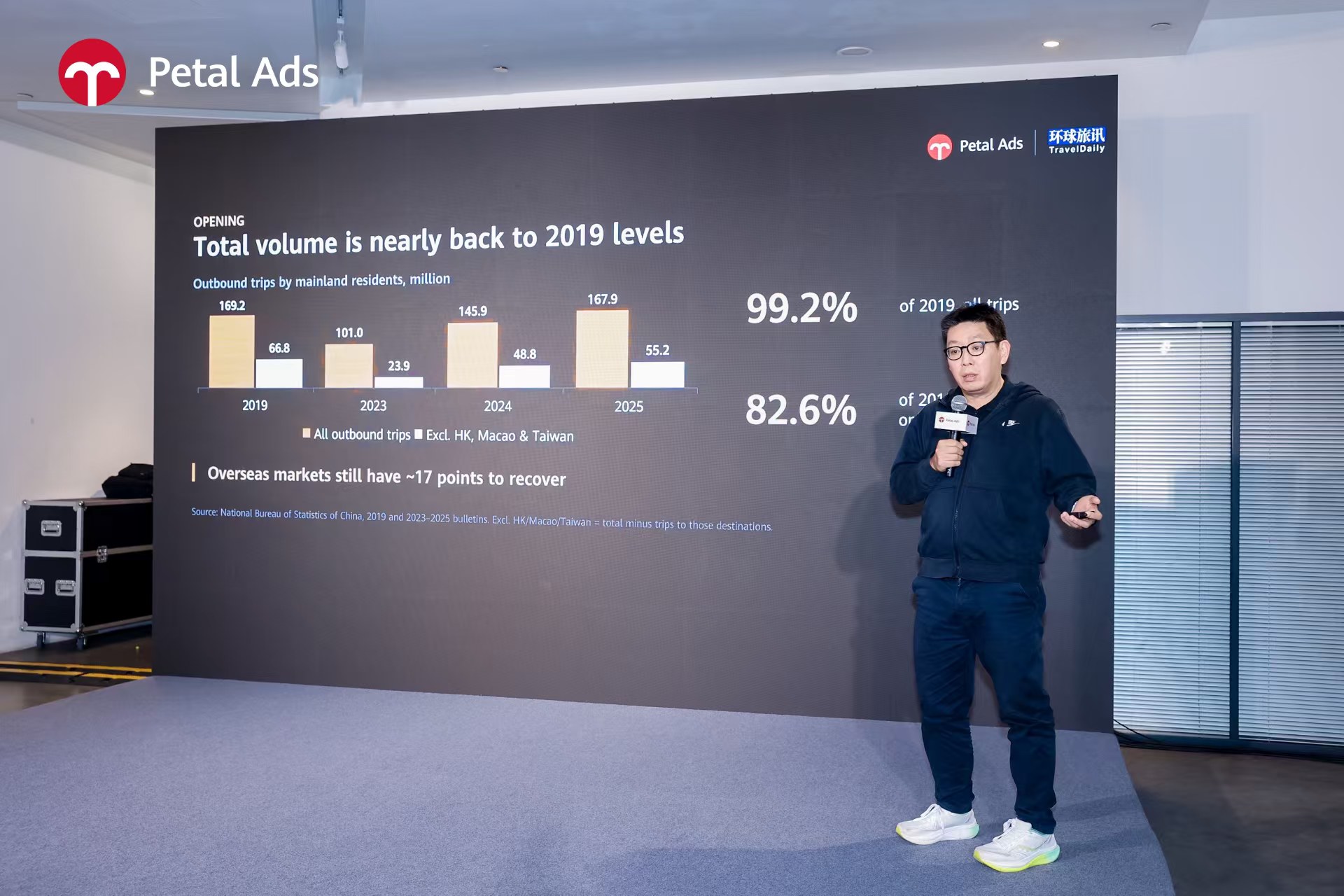
In a recent keynote presentation themed Where China Travels Next: How Chinese Outbound Travelers Are Changing, 2026–2027, Charlie Li, CEO of TravelDaily, examined the structural shifts taking place in one of the world's most important outbound travel markets, shared his predictions for 2027, and outlined how international travel brands can respond.
Beyond recovery: A market undergoing structural change
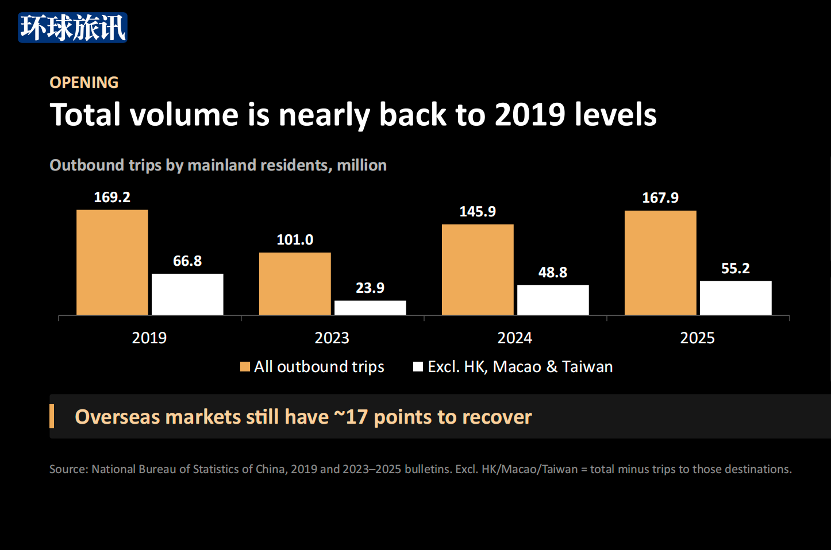
Mainland Chinese residents made approximately 168 million outbound trips in 2025, equivalent to 99.2% of the 2019 level. However, excluding Hong Kong, Macao and Taiwan, overseas trips reached approximately 55.2 million, representing only 82.6% of pre-pandemic levels.
Growth has continued in 2026. Based on TravelDaily's calculations from official figures, mainland residents made approximately 136.5 million outbound trips in the first nine months of the year, up 9.4% year on year.
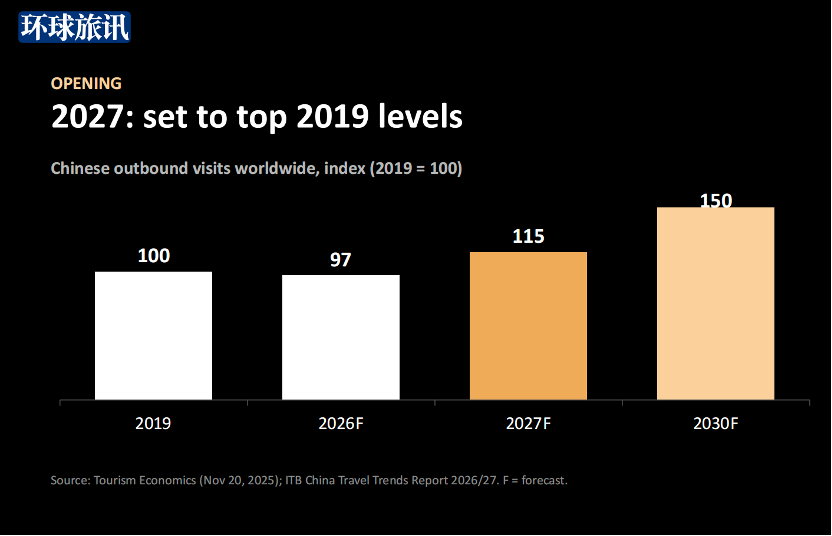
Tourism Economics forecasts that Chinese outbound visits worldwide will exceed pre-pandemic levels by 15% in 2027 and reach approximately 150% of the 2019 level by 2030.
For Li, however, the more compelling story lies beneath these recovery figures.
Where are Chinese travelers going? How are they traveling? And what are they willing to pay for?
Li identified four major shifts that are reshaping the market and opening up new opportunities for international travel businesses.
Further and longer: Expanding the travel map
While short-haul destinations in Southeast and Northeast Asia remain central to Chinese outbound travel, longer holidays and improved air connectivity are expanding travelers' choices.
According to Ctrip's holiday travel research, the proportion of outbound leisure travelers taking trips lasting eight days or more increased from approximately 29% in 2024 to 42% in 2026.
Europe illustrates both the opportunity and the complexity of long-haul demand.
A 2026 European Travel Commission survey found that 54% of Chinese respondents planned to visit Europe between September and December, down 15 percentage points year on year. However, the proportion who had already booked flights increased from 33% to 37%. Among those planning a European trip, 61% were first-time visitors.
Meanwhile, China's international passenger flight network continues to expand. The 2026–2027 winter schedule covers 84 countries, compared with 80 the previous winter, with weekly international passenger flights increasing by 4.1%.
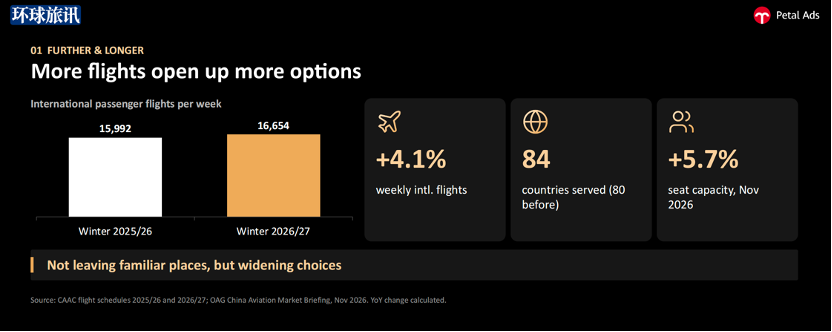
Li observed that Chinese travelers are retaining their interest in familiar destinations while expanding the range of places they are willing to explore.
For long-haul destinations, the opportunity lies in making travel more accessible while offering compelling reasons for visitors to stay longer.
Deeper: Redefining what is worth paying for
Another important shift is how Chinese travelers define value.
According to Fliggy, outbound travel spending grew by 4.4% in 2025, while average spending per traveler remained flat. Alipay data also indicated a shift towards smaller, more frequent purchases.
Yet Tourism Economics estimates that Chinese travelers spent an average of USD 473 per night overseas in 2025, compared with USD 393 in 2019, ranking highest among 11 major source markets.
These figures suggest that Chinese travelers remain valuable customers, even as they become more selective about their spending.
A survey of 1,404 prospective outbound travelers by Jiguang Moonfox Data also found that dining, activities and shopping accounted for approximately 48–49% of respondents' planned travel budgets across short-, medium- and long-haul trips.
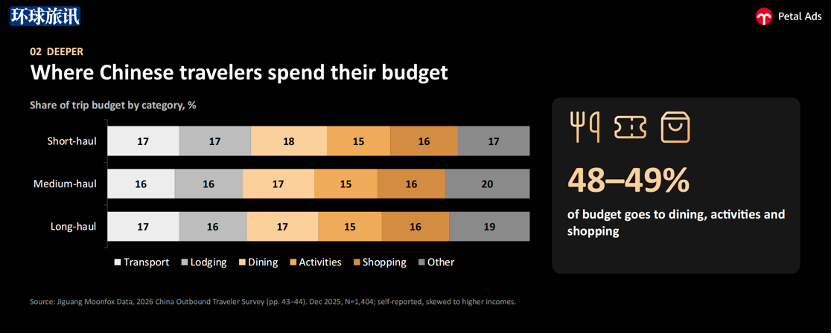
The commercial opportunity therefore extends well beyond flights and accommodation.
Li highlighted three areas where travelers are increasingly willing to pay a premium: authentic local experiences, demonstrably better service, and greater flexibility and personalization.
For international travel brands, understanding what Chinese consumers consider worth paying for is becoming increasingly important. Cultural immersion, distinctive experiences and high-quality services can provide stronger differentiation than price competition alone.
Wider destinations, narrower interests
One of Li's most striking observations is that Chinese travelers are exploring a wider range of destinations while developing increasingly specific travel interests.
Although Asia-Pacific continues to dominate outbound travel, emerging destinations are gaining momentum.
In 2025, Georgia recorded approximately 130,000 overnight visitors from China, up 44%, while Brazil welcomed more than 100,000 Chinese visitors, up 34%. Egypt also recorded growth of more than 20% in Chinese visitor numbers.
Li identified three forces behind the rise of emerging destinations: easier access, distinctive experiences and sustained investment in destination marketing.
Equally important is the growing differentiation within the Chinese traveler population.
First-time outbound travelers, including those from smaller Chinese cities, tend to prioritize safety, convenience and reassurance. Experienced travelers from major cities are more likely to seek novelty, cultural depth, personalization and higher service quality.
This distinction is creating opportunities for increasingly specialized travel products, from themed cruises and expedition voyages to bespoke luxury itineraries and immersive cultural experiences.
“Destinations do not need every Chinese traveler. They need the right ones, with a unique reason to visit,” Li noted.
Smarter: AI and the connected travel journey
Technology represents another dimension of change.
According to Tourism Economics, the proportion of global travelers using AI chatbots or virtual assistants to plan international trips rose from 10% in 2024 to 18% in 2025.
Li believes AI, smart devices and connected digital ecosystems could fundamentally change how travelers interact with travel businesses.
Today, travelers frequently switch between multiple platforms to discover destinations, compare products, make bookings and access local services. In the future, AI-powered assistants could bring many of these activities together into a more seamless experience.
For travel businesses, Li suggested, the next competitive advantage may come from reducing complexity rather than simply adding more digital features.
“The traveler sees one journey. The industry has to learn to connect the touchpoints.”
Three predictions for 2027
Looking ahead, Li expects three developments to shape Chinese outbound travel in 2027:
First, growth will become more diversified. First-time travelers from smaller cities will generate incremental demand, while experienced travelers will drive growth in emerging destinations, long-haul trips and specialized travel products.
Second, experience value will outweigh price alone. Consumers will remain rational about spending but will reward brands that offer distinctive experiences, cultural depth, comfort and customization.
Third, AI will reshape travel decisions. Inspiration, search, planning, booking and in-destination services will become increasingly interconnected, requiring travel brands to adapt to new consumer interfaces while safeguarding privacy, security and service quality.
What global travel brands should do next
To capture the next wave of Chinese outbound travel demand, Li recommends that international tourism boards, airlines, hotels and travel service providers focus on three strategic priorities.
The first is to target travelers by motivation. Traditional demographic segmentation should be complemented by a deeper understanding of why people travel and what they hope to experience.
The second is to compete on experience value. Destinations can differentiate through immersive cultural products, hotels through local character and personalized services, and airlines through comfort, connectivity and a better overall journey.
The third is to engage travelers throughout the entire journey, extending brand relevance beyond the booking stage to inspiration, planning, in-destination experiences and post-trip engagement.
As Chinese outbound travel moves beyond recovery, the market will become larger, more diverse and more demanding.
In Li's view, the global travel brands best positioned for future growth will be those that understand the changing motivations of Chinese travelers and translate that understanding into products, services and experiences that give them a genuine reason to choose one brand or destination over another.