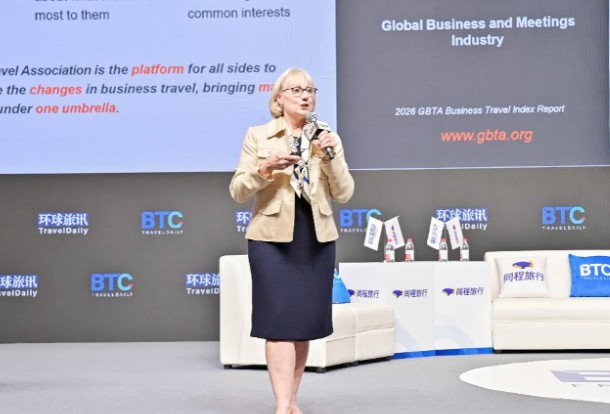

At TravelDaily's 2026 Digital Intelligence Conference · Shanghai Edition on April 2, TravelDaily CEO Charlie Li and Jason Li, General Manager of Guangzhou Lvxun Digital Technology Co., Ltd., provided in-depth analyses of the annual business travel report Tides Rising in the East - The Expanding Reach of China's Business Travel.
At the start of the event, Charlie Li outlined the overall market landscape from the perspective of suppliers and channels. He noted that corporate travel demand is shaped by a “triangular balance” among cost control, employee experience, and compliance risk.
During his presentation, he shared a set of budget forecast data for 2026, emphasizing that control remains the top priority for enterprises.
The survey revealed that only a small fraction of companies expect a “significant increase” in travel budgets. For the vast majority—over 70% of enterprises—budgets are expected to remain roughly the same or increase only slightly.
This sense of tightening is directly reflected in corporate hotel standards.
Regarding adjustments to hotel travel policies, most companies remain stable: 72% keep standards unchanged, 12% proactively lower them, and only 4% raise them.
On the regional front, Charlie Li highlighted a critical finding: a severe mismatch between strong demand in lower-tier markets and the quality of available supply.
In the survey sample, business travel to third- and fourth-tier cities accounted for 40% of trips. However, service quality in these markets has not kept pace.
About a quarter of respondents reported that hotels in lower-tier cities are “bookable but fail to meet expectations,” often due to prices exceeding policy limits or poor value for money.
Charlie Li stressed that technological connectivity remains the biggest obstacle. According to the survey, only about 30% of hotels currently provide API connections directly with TMCs, while most still rely on inefficient booking via email or phone.
Looking ahead, leading hotel groups such as H World and IHG are accelerating API integration with corporate clients, aiming to align corporate rates with individual membership benefits. By recognizing employees’ personal membership status within TMC channels and matching perks like breakfast, points, and room upgrades, hotels can enhance traveler experience and strengthen brand loyalty.
Jason Li then shifted the perspective to the buyer side, first correcting a common misconception:
In many financial statements, business travel appears as an expense; from a macro perspective, however, travel is an investment. Data show that globally, every dollar spent on business travel generates 72 dollars in actual output.
Yet efficiency differs between China and the U.S.: in the U.S., every dollar of travel spending generates 77 dollars in output, compared to 47 dollars in China.
Jason Li explained that this stems from China’s industrial structure—particularly manufacturing. Manufacturing requires extensive on-site equipment debugging and production line installation, making physical presence essential. This “on-site necessity” underpins the strong expansion potential and rigid demand of China’s corporate travel market, linking it closely to the economy.
The survey also found that 50% of travel managers have less than three years of experience. In terms of management structure, 38% of travel functions report to administrative departments and 21% to procurement. This means that hotels and TMCs often interact with administrative personnel without specialized business travel expertise.
Additionally, 33% of respondents struggle to ensure employees do not feel overburdened by travel, while 25% of companies are under pressure to spend less. These pressures have contributed to the rise of cashless reimbursement and corporate monthly billing.
Within this ecosystem, TMCs face a delicate survival challenge. Jason Li noted that corporate clients are no longer satisfied with single-service offerings. The survey shows that 60% of companies have started introducing competition among multiple TMCs or allow employees to compare prices on other platforms.
Through these insights, the future contours of China’s corporate travel market are becoming clear.
It is a transition from experience-driven to data-driven management. Hotels can no longer rely solely on geographic location; they must address technological gaps through API integration. On the corporate management side, companies must use data to balance cost and experience, even as 72% keep their hotel standards unchanged.