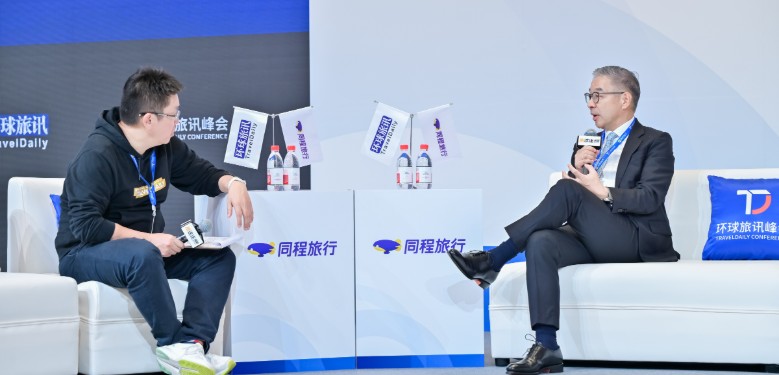
At the 2026 TravelDaily Conference, Kent Zhu, CEO of Accor Greater China, sat down with Charlie Li, CEO of TravelDaily, for a discussion titled “Beyond Scale, Beyond Luxury: International Hotel Groups’ Next Chapter in China.” Zhu shared his perspectives on China’s evolving hotel market, changing consumer preferences and the impact of technological transformation.
In Zhu’s view, international and domestic hotel groups each have their own competitive strengths. For luxury and upscale brands, however, the real priority is understanding how consumer expectations are changing.
Zhu took over as CEO of Accor Greater China in May 2025. Reflecting on his time in the role so far, he noted that Accor has built a presence in China over more than four decades. Yet amid an increasingly competitive market, the group needs to further refine its strategy.
One key priority is to restructure its commercial operations to provide stronger support for hotel owners. Another is to step up brand marketing and raise Accor’s profile in China.
Zhu acknowledged that Accor had traditionally taken a relatively low-key approach to marketing. As competition intensifies, however, the group needs to communicate its brand value more proactively to the market.
These adjustments reflect broader changes in China’s hotel industry.
International hotel groups have historically enjoyed strong brand advantages in the upscale and luxury segments, while domestic hotel groups have built their competitive edge through a deeper understanding of local consumer demand, distribution channels and operating conditions, alongside rapid expansion and localized operations.
Today, this once relatively clear division is becoming less distinct.
International hotel groups are expanding into more lower-tier cities, while domestic groups are moving further upmarket into the upper midscale segment. As their products, customer segments and geographic footprints increasingly overlap, competition is intensifying, while new opportunities for collaboration are also emerging.
Zhu noted that leading domestic hotel management companies have developed strong market insights, extensive distribution reach and sophisticated capabilities in applying technology. International hotel groups, by contrast, still need to deepen their understanding of certain China-specific consumer needs and operating conditions, despite their global scale and resources.