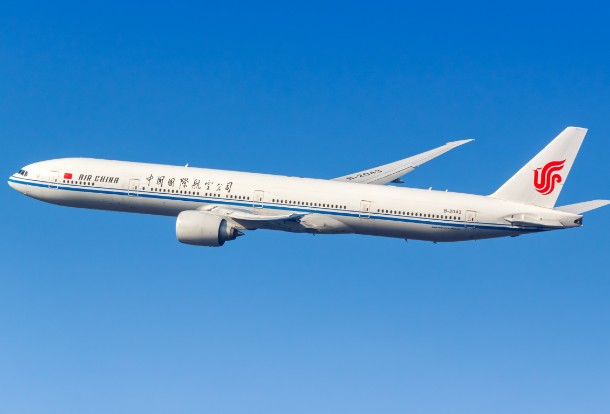
After the disruption in the Middle East, Asia–Europe routes that once relied heavily on Middle Eastern transit hubs have been forced to reroute on a large scale—driving a sharp surge in airfares on China–Europe and Southeast Asia–Europe routes.
Amid this shift, a narrative has begun circulating: with the Middle East in turmoil, Chinese airlines could emerge as the biggest winners.
On the surface, the disruption of Middle Eastern hubs has indeed created new opportunities for Chinese carriers.
Data from VariFlight shows that in February, Chinese mainland airlines operated 31,890 flights on China–Europe routes, compared with 14,255 by international carriers.
Civil aviation expert Xiaojin Li noted in an interview that with transit options in the Middle East constrained, some passenger and cargo flows are likely to shift elsewhere.
However, a shift in demand does not translate into an increase in capacity.
International routes cannot simply be added at will. Flight frequencies are constrained by traffic rights, airport slots, and fleet size. In the short term, Chinese airlines are unlikely to significantly ramp up capacity.
Even if ticket prices on some Asia–Europe routes rise, the overall profitability of Chinese airlines still faces considerable pressure.
The first issue lies in route structure.
Many assume that Chinese carriers can offset losses in other markets—such as the heavily impacted Japan routes—through higher fares on European routes. However, industry consensus suggests there is little substitutability between the two.
Japan routes are primarily served by narrow-body aircraft, while Europe routes require long-haul wide-body aircraft. The two differ fundamentally in capacity structure.
A bigger pressure comes from costs.
Aviation fuel typically accounts for around 30% of an airline’s operating expenses. Geopolitical conflicts are often accompanied by rising oil prices, creating a direct cost shock for the industry.
Another structural reality for Chinese airlines is that the domestic market still dominates their business.
Senior aviation expert Jia Guo points out:
“Domestic routes face intense competition from high-speed rail. If airfares are significantly higher than train tickets, many passengers will switch to rail. As a result, even when fuel surcharges rise, airlines often have to lower ticket prices to maintain passenger volumes—further squeezing profit margins.”